
Marisol
Available Works

Marisol
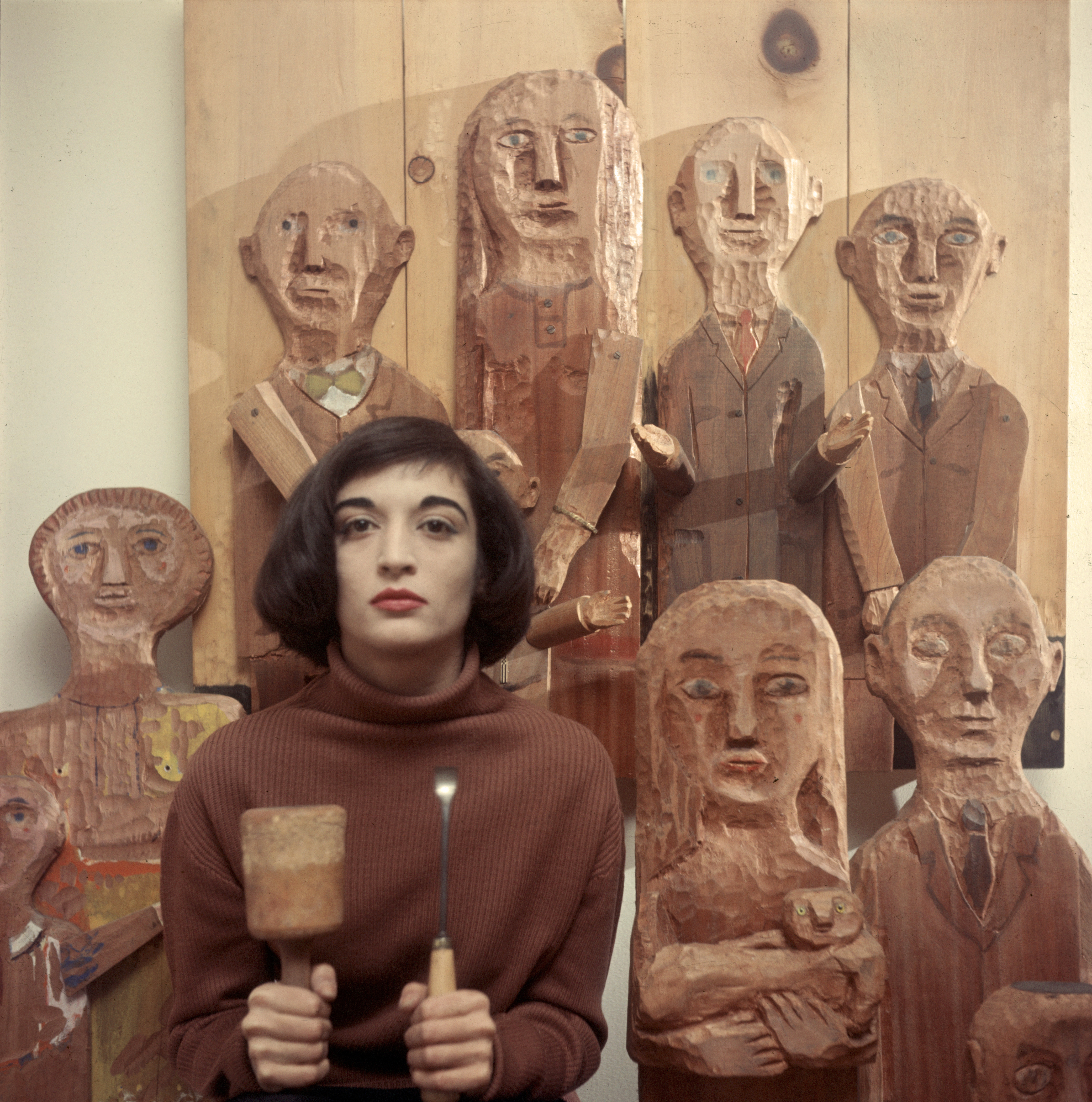
Marisol (1930–2016) occupies a singular position within the landscape of postwar American art, resisting easy alignment with any one movement while traversing the visual languages of Pop, Folk Art, and contemporary figuration. Emerging prominently in the early 1960s, she forged a distinctly personal vocabulary in the wake of the male-dominated ethos of Abstract Expressionism. Celebrated by Andy Warhol as the “first lady of Pop,” Marisol became renowned for her life-sized wooden figures—enigmatic sculptural assemblages whose mask-like faces, frequently cast from the artist’s own likeness, confront the viewer with both theatricality and introspection.
Across her oeuvre, Marisol infused ordinary objects and domestic references with psychological weight, constructing narratives that probe the tensions embedded within family structures, gender roles, and social performance. Her landmark work “The Party” (1965), composed of fifteen female figures—most bearing variations of her own visage—epitomizes this approach. Through their rigid, box-like forms and deadpan presence, the sculptures oscillate between satire and empathy, revealing the quiet absurdities and universal rituals of human interaction.
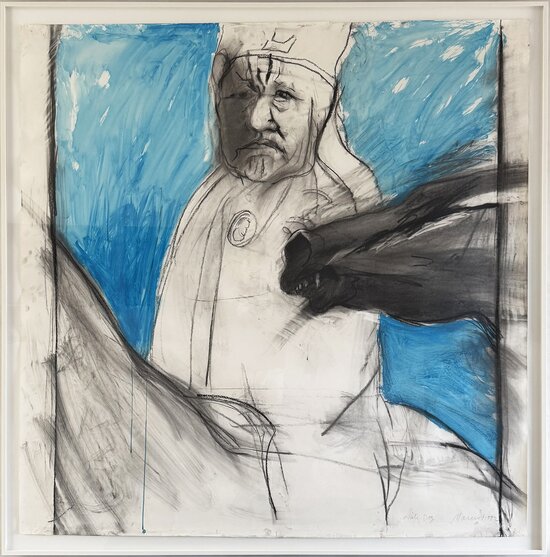
In the early 1990s, Marisol extended her incisive social commentary through a series of portrait sculptures of prominent Native American leaders, presented in a 1995 solo exhibition at Marlborough Gallery in New York. From this body of work the 1992, “White Dog,” stands apart as an especially rare and compelling drawing on paper. Depicting the Native American Chief White Dog adorned with a Lincoln Indian Peace Medal, the work invokes the fraught history of these medallions, distributed during the nineteenth century as symbols of both governmental “recognition” and forced cultural assimilation.
While deeply connected to the sculptural concerns of this period, “White Dog” distinguishes itself through its graphic immediacy and expressive surface. The figure emerges with striking solidity at the center of the composition, surrounded by gestural, painterly marks that evoke both motion and stillness. In this dynamic tension, Marisol captures not only the physical presence of her subject, but also the layered histories and unresolved contradictions carried within the portrait itself.
Text below from; Buffalo AKG Art Museum. https://buffaloakg.org/person/marisol
One of the most prominent artists of her generation, whose innovative work helped define the 1960s, Marisol (Venezuelan and American, 1930–2016) was born María Sol Escobar in Paris to a Venezuelan family. The family moved back to Venezuela around 1935, and Marisol spent her early years traveling between New York and Caracas. She drew continually from a very young age, and she adopted the name Marisol—which alludes to the Spanish words for “sea” and “sun”—in her early teens. She would use Marisol as her professional name for the rest of her life. In 1946, her family moved to Los Angeles, where she studied art at the Otis Art Institute and with Howard Warshaw at the Jepson Art Institute. She then briefly attended the Académie Julian and the École des Beaux-Arts in Paris before moving around 1950 to New York, where she took classes at the Art Students League (between 1951 and 1963); studied with Hans Hofmann (at his studios in New York and also in Provincetown, Massachusetts, between 1952 and 1955); and attended the New School for Social Research (in 1952) and the Brooklyn Museum Art School (between 1955 and 1957).
Like many of the artists who emerged in the early 1950s, Marisol was at first strongly influenced by the prevailing school of Abstract Expressionist painting. She came to know many of the figures associated with this group and was friends with artists such as Willem de Kooning. After seeing pre-Columbian art in Mexico while visiting her father and in a New York gallery show in the early 1950s, Marisol began making sculpture in 1954. At first she worked on a relatively small scale in terra-cotta and in wood, and used the lost-wax method of casting in bronze. Within a few years, however, she began focusing on life-size, totemic figures. These mixed-media assemblages combined wood with painting and found objects in a style that was sometimes quizzical or satirical but always highly accessible. When the Pop art movement emerged, Marisol’s works were often associated with it, although her sculptures were also distinct from the observations on mass media and mass culture put forward by friends and peers such as Andy Warhol. Marisol later stated, “I started doing something funny so I would be happier—and it worked.”
Marisol’s work quickly drew the attention of the legendary art dealer Leo Castelli, who in 1957 included her in a show along with Jasper Johns and Robert Rauschenberg and gave her a solo exhibition at his gallery. Wider public acclaim came in 1962, following her first solo exhibition at Eleanor Ward’s Stable Gallery. The Albright-Knox Art Gallery was the first museum to formally acquire a sculpture of Marisol’s with a purchase from that show, and LIFE magazine featured her in its “Red-Hot Hundred” list. Images of Marisol’s work, reproduced in LIFE and elsewhere in the popular press, extended her reputation far beyond the art world. Her 1964 exhibition at the Stable Gallery received up to two thousand visitors a day, and her first solo show at the Sidney Janis Gallery in 1966 was even more popular. During the exhibition’s run, there was a regular queue of people waiting to see the remarkable life-size figures, many of which addressed the role of women in society and included plaster casts of Marisol’s own face and hands.
Marisol became widely known not only for her powerful work but also for mingling in much-publicized creative social circles, including with associates of Warhol’s Factory. Warhol called her “the first girl artist with glamour” and cast her in two of his films: Kiss and The 13 Most Beautiful Women, both 1964. In 1968, Marisol represented Venezuela at the Venice Biennale and was one of only four women among the 149 artists selected for that year’s Documenta exhibition in Kassel, Germany.
Although she would withdraw from the New York art scene for long periods of travel, Marisol continued her work in sculpture while she also explored other mediums, such as drawing, printmaking, and photography, and took on commissions. LIFE commissioned a portrait of John Wayne in 1963 that was reproduced from all angles in the pages of the magazine, and her works were featured on the cover of Time magazine at least four times throughout the decades. In the early 1970s, her travels inspired a series of carved and cast sculptures of fish, and she also embarked on a series of expressive, large-scale drawings whose bright colors belie their often-violent subject matter. She designed sets and costumes for dance companies such as those of Louis Falco, Martha Graham, and Elisa Monte, and she would eventually create public monuments to historical figures around the world.
In the late 1970s Marisol focused on portrait sculpture, creating homages to Graham, Pablo Picasso, Marcel Duchamp, Georgia O’Keeffe, and de Kooning, among many others, and this body of work was celebrated in the 1981 exhibition Artists and Artistes by Marisol at the Sidney Janis Gallery. The National Portrait Gallery in Washington, DC, also focused on this aspect of her practice in 1991’s Magical Mixtures: Marisol Portrait Sculpture.
In the 1980s Marisol made a number of works that address poverty and social injustice, and in the 1990s she embarked on a series of portrait sculptures of famous Native Americans, the focus of a 1995 Marlborough Gallery exhibition.
A major retrospective exhibition organized in 2014 by the Memphis Brooks Museum of Art, Marisol: Sculptures and Works on Paper, subsequently traveled to El Museo del Barrio in New York, stimulating fresh critical interest in her immense and varied achievement.
Upon her death in 2016, Marisol bequeathed her estate to the Albright-Knox Art Gallery (now the Buffalo AKG Art Museum), including more than 100 sculptures spanning the entirety of her 60-year career, more than 150 works on paper, thousands of photographs and slides, a small group of works by other artists that Marisol had collected, and the artist’s archive, library, studies, tools, and New York loft apartment. With this bequest, the Buffalo AKG now holds the world’s most significant collection of Marisol’s work, bringing extraordinary depth and richness to the museum’s superb collection of Pop art and modern sculpture. The Buffalo AKG was the first museum to formally acquire Marisol’s work, having purchased the sculptures The Generals, 1961–62, from her solo show at the Stable Gallery in 1962 and Baby Girl, 1963, in 1964. Marisol developed an enduring respect for the Albright-Knox and people associated with it, including the museum’s important patron Seymour H. Knox, Jr., and Buffalo native Sidney Janis, her longtime friend and her dealer from 1966 until his death in 1989.
Works by Marisol are included in the collections of many major museums, including those of the Buffalo AKG Art Museum; the Art Institute of Chicago; The Metropolitan Museum of Art; The Museum of Modern Art, New York; The Rose Art Museum at Brandeis University; the Smithsonian Museum of American Art; and the Whitney Museum of American Art.